
Bible Scholar Answers Questions about the Old Testament
Dr. Dominick Hernández joins CKR to answer the internet’s honest questions about the Bible.
TEXT SUPPORT
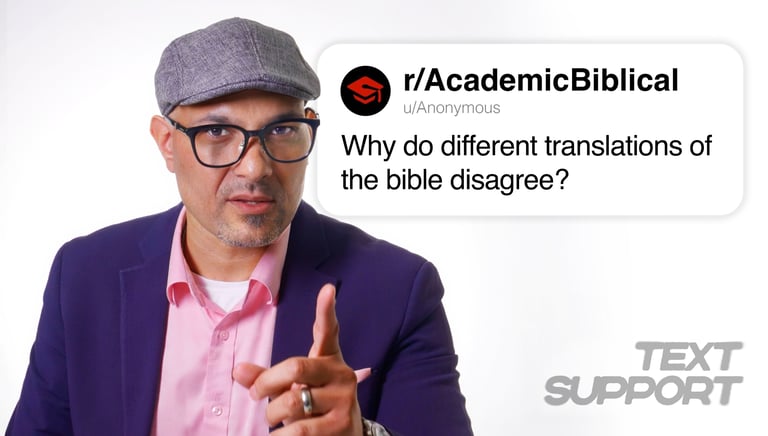

Hello, I'm Dr. Dominick Hernández, professor of Old Testament and Semitics. And I'm here to answer your questions from the internet about the Bible. This is Text Support.
Why do different translations of the Old Testament often disagree?
Well, reason number one is that the Old Testament was written in a different language than English or the modern language that you might read. Anytime you translate from one language into another, there's always going to be differences in interpretation. Another thing that we should consider about contemporary translations is sometimes, as contemporary readers, we hold them to too high of a standard then what they actually were intended to fulfill. Many versions actually have a goal. Those goals frequently dictate the type of language that you're going to get in a translation Because remember, you cannot translate without there being an element of interpretation. Another reason sometimes texts are revealed throughout history that help us nuance and even make better the translations that we have. For example, the Dead Sea Scrolls were found in the middle of the 20th century and when the Dead Sea Scrolls were found, the Dead Sea Scrolls had manuscripts that were much older than the manuscripts that we normally translate our Old Testament from. There's actually what we call a text critical issue here. So text criticism is when scholars of the Bible look at all of the potential versions of the Bible, they look at all the manuscripts and try to get back to putative original forms. Translators have to make a choice. Do we keep the traditional manuscript's rendering, or do we incorporate the older manuscript that has a slightly different reading? Nevertheless, those are just a couple of reasons as to why there are differences in translations in our contemporary versions.
Next question is, Did God create the world in six days?
Anyone that believes in the God that the Bible presents would say that God has no problem creating the world like that [snaps]. The question really is, are the accounts of creation in Genesis 1 and 2 actually depicting material creation in six literal days? It seems like modern readers are really concerned about material creation. That God created is important, but is it as important in that text as we make it today? And I would say probably not. And the reason why is because it's not even close to a comprehensive account. It's very stylized. It's pretty important to note that the days line up with one another, and it doesn't even intend to talk about everything. No reader of Genesis 1 and 2 would say the author there is striving to be comprehensive. Could God have created in six literal 24-hour days? Yes. Is that what the Genesis account is necessarily saying? I'm not so sure. But do we understand that the God of Genesis is the same God that created everything—by holding Genesis 1 and 2 up in light of what lots of the other scriptures say about that same God? Yes.
The next question says, Where do we see Satan—capital S—in the Old Testament?
We read in Genesis 3 that there is a serpent in the garden that tempts Adam and Eve. They both eat from the fruit and then there are consequences. The interesting thing about that passage is that the word satan doesn't show up in that passage. Hold on a second, though. As we continue to read, we get to the book of Job and we actually read that many of our translations have the word Satan capitalized there. And we're like, "Oh, Satan shows up there." Okay, well, here's the deal: we don't normally put articles—the word, "the"—before names. And in Job the word "the" shows up before satan. It doesn't necessarily mean that satan isn't there, but what it does mean is that there isn't a proper name Satan there. But the proper name does show up in 1 Chronicles 21:1. "Then Satan stood against Israel and incited David to number Israel." It's very clear that the chronicler believes that there's a proper name, Satan. There's some sort of really bad figure that incites David to do something not good. Now let's think, was the satan in chapters 1 and 2 of Job actually Satan, capital S? It could have been. It does seem that the satan in that context challenges God's system of just retribution by way of Job. That sounds pretty bad. Then we go back to the beginning, Genesis 3, and we read that there was this serpent evidently talking, challenging what God had really said to Adam and Eve. So it does seem, just by reading the Old Testament that the character we see show up in Job, and the character we see show up in Genesis 3 could be the same Satan that we see in 1 Chronicles 21. Throughout the New Testament who Satan is in Christian theology is ironed out for us. But I do think at least bare minimum, Satan does show up in 1 Chronicles 21:1 and I think we understand where he might show up elsewhere based upon that passage.
Next question is, What should we make of Job's friends advice?
Good question. Seems like Job's friends really want to help him, right? Many of the things that they say to Job sounds so right to our ears. "Job, wicked people suffer the consequences of their sin. Job, turn back to God and things are going to get better." Is that what's really happening? I don't think so. Here is how we know: Job, when he begins to suffer, he says some really radical things. For example, in chapter 9, Job says that God perverts justice. Well, Job seems to say things that aren't right about God. But remember, Job is a person of integrity. We're told that repeatedly in the Prologue, in the first two chapters. We're never told that about Job's friends.However, they take language that sounds so right. Can we even say so godly? And they use it in a manipulative way to get Job to ascribe to their system of just retribution, to their theology! Job won't have that. By the time we get to the end of the book, we are able to see what to make of Job's friends speeches. In Job 42:7-8, we read, "After the Lord had spoken these words to Job, the Lord said to Eliphaz" Job's first friend, "my anger burns against you and against your two friends, for you have not spoken of me what is right as my servant Job has." Hasn't God been paying attention to what Job just said about him in the previous chapters? And Job's friends sounds so right! What do you mean they haven't spoken rightly? Well, Job's friends used all of this right sounding language to create a system in which God was also simply a player in their system. Now here's why this is important. Frequently in churches, people will quote from the Book of Job something that sounds nice—from Job's friends. God says they spoke wrongly about me. Let's not quote them out of context as if they're doing something different.
Next question is, Why does my Bible capitalize every letter in Lord: L-O-R-D?
Great question. This also relates to the question as to why sometimes the Bible refers to God as God, and other times refers to God as Lord. Whenever we see the name capital L, capital O, capital R, capital D, it is not just a title, but a name. That name stems from—and maybe the most well-known passage—Exodus 3:14. Now, in the context, Moses is being commanded by God to go back and get his people from Egypt. And he's hesitant. He says to God, who should I tell them sent me? "God said to Moses, I Am who I Am. And he said, say to the people of Israel, I Am has sent me to you." Now that phrase, I Am who I Am is אֶהְיֶה אֲשֶׁר אֶהְיֶה based upon the verbal root הָיָה means "to be" or something like that. אֶהְיֶה is an imperfect form. It means "I am, I continue to be, I will be, I was." It's continuous. This is the to be God. This is the ever existing God. This is the God that was, is and will always be, אֶהְיֶה אֲשֶׁר אֶהְיֶה. Some people take the pronunciation of that very seriously, and would rather not try to pronounce it so as not to take the Lord's name in vain. And so in our contemporary Bibles, whenever that Tetragrammaton, that four letter name for God appears, it appears as capital L capital O, capital R, capital D. What this means is that every time we come across that LORD capitalized, we know that we're talking about the name of the personal God of the people of Israel who sent Moses back to get the people of Israel out of Egypt. Now there are other different general ways to say God: Elohim (אֱלֹהִים), El (אֵל), Eloah (אֱלוֹהַּ), those are all ways to say God. But there's only one way to say the name of the God of Israel, the one that said אֶהְיֶה אֲשֶׁר אֶהְיֶה. Yes, that's what's represented by capital L, capital O, capital R, capital D.
The next question is, Why do the Psalms have prayers of judgment?
Now, this question seems to relate to what are called Imprecatory Psalms that are verses in the Bible that seem to bring about judgment upon other people perceived to be the enemies of the writers. This is exemplified in, for example, maybe one of the most well-known and imprecatory versus Psalm 137:9 that says, "Blessed shall be he who takes your little ones and dashes them against the rock." There's clearly no excuse for taking little ones and banging little ones heads against the rock or anything like that. Rather, what we see here are genuine sentiments from a biblical writer. Poetry that reflects genuine human emotion. Now that genuine human emotion is not always what we would consider to be right, but when it's genuine, it's still good. They're different. It's always good to be open and honest about what you are feeling in any given moment, at least to yourself. There's an element of self-awareness that we have to have in order to be even good readers of the Bible. We have to admit how we feel about certain things before we can even deal with them. Now, what we feel about things is not always what God would have us feel about things, but rather what we have here is a genuine sentiment of what's depicted as a person, but maybe a group of people that were exiled that had seen maybe something like this happen to their children, and they're speaking out from a place of integrity. This is what retribution is in our eyes! That doesn't mean we imitate it, unless, of course, we're imitating their honesty.
The next question asks, Did the Old Testament authors use sources?
This is a yes or no question, and the most reasonable response is yes. So when people are asking about whether or not the Bible used sources, they might be actually asking two different things. They might be asking, did the authors that we know of maybe like a Moses or an Isaiah or the chronicler, use sources to put them together? And it seems reasonable to suggest that they did. Frequently, however, when people ask this question, what they're asking is about Source Criticism that looks at the historical layers underneath the text that we currently have, and posits that there may have been putative other sources. So, for example, scholars look at the Torah that we have today, what Christians call the Pentateuch. Some would say that there are at least four sources there. J which frequently used the word Yahweh to refer to God's name. E which liked to use the word Elohim to talk about God. D, the Deuteronomist, which was basically a historian that had his own particular style and P a priestly source that wrote about the priestly things and the sacrificial system. Now the question is whether we should accept some of those theories that posit sources that are not congruent with what the Bible says about itself. And the traditional position, and the position that I take, is that we shouldn't. Sources? Yes. Incongruence with what we currently have? No.
Our next question is, Why do we talk about God as a man?
In the Ancient Near East, there were gods and there were goddesses, and the God of Israel is depicted as a god and not a goddess. But you know, the God of Israel is also depicted as a mother sometimes, that is metaphorically, and is also depicted as even, you ready for this, a bird that takes care of chicklings or something like this underneath the bird's wing. So there are different depictions of God, but the biblical authors are consistent in using masculine language for God. It seems that this wasn't totally random, but maybe we're not supposed to think of God as some sort of ultra masculine figure. Infact, God is not masculine like I as a human being am a male. We read in the beginning of the book of Genesis that both men and women are created in the image of God, and so there's something about God that fulfills all of what it is to be masculine, and all of what it is to be feminine, since all human beings somehow, some way bear his image. But what is important is the consistency that we see throughout the scriptures of the masculine pronoun being used to talk about the God of Israel. It's important to continue to utilize that language so that we can continue to portray what the biblical writers were portraying by utilizing that language.
Our next question here is, What's more important: faith or reason?
This question is a false dichotomy. We don't have to choose. Faith isn't the opposite of reason. Faith isn't going, "Oh! Ah!" and coming up with something to believe in. Rather, we tend to draw reasonable conclusions that we can't always prove. And that's where the step of faith comes in. For example, I love my mother's good Puerto Rican cooking. If I am in my mother's house and I hear some pots clanking around and I hear her opening and closing the refrigerator, and all of a sudden I hear [*sizzlingsounds*] and I smell the oils, and it starts to smell like rice and beans, but I'm in another room, it becomes reasonable to suggest that she might be making one of my favorite dishes. I'm putting all of my faculties together and taking that little step that says, You know what? I believe based upon what I know that this next step is a reasonable step, you ready, of faith. That seems to be what I think reasonable faith is particularly reasonable faith in the God of the Bible. We're not going to always know everything, but we can utilize our reason, our ability to observe and work things out to get to the point where we say, You know what? That next step, even if it's of faith, is a very reasonable one.
Our next question is, Solomon was a heretic at the end of his life, yet we have books with his name on them. What are we supposed to do about that?
Yes, Solomon is depicted as somewhat of an apostate by the end of his life. And then we have sections of the Bible that bear his name. So let's talk about some of these sections of the Bible that are generally attributed to Solomon. We'll start off with number one, top of the list, Proverbs. People tend to attribute the entirety of the Book of Proverbs to Solomon, but that opinion leaves out very important facts about the book. In Proverbs 25:1, we read that the men of Hezekiah are mentioned. Hezekiah came several hundred years after Solomon, so that means the book had to have been put together after Solomon, like lots after Solomon. And then in chapter 30 we read, these are the words of Agur. Agur is not Solomon. And in chapter 31 we read that these are the words of Lemuel's mother. So it seems we have at least those sections in the book of Proverbs that point to the fact that Proverbs as a book was compiled by someone else that we don't know. Let's pause there, draw some conclusions after we talk about the next one. Ecclesiastes, the book of Kohelet. That word comes from the first verse of the book of Ecclesiastes, which says "The words of the preacher, the son of David, King in Jerusalem." People frequently think that this is the son of David, Solomon. Now David had a lot of sons. Now there are some areas of the book of Ecclesiastes that maybe make us think that this may have been Solomon, but there are other areas that make us think that this may not have been Solomon. We don't know who the ultimate compiler of Kohelet or Ecclesiastes is, simply because Solomon is never explicitly mentioned. What should we make of Solomon's words showing up in these books? We recognize that God, throughout the scriptures uses people that are willing and knowing, as well as people that are unwilling and unknowing in order to be able to communicate his divine truth. At the end of the day the compiler, the person that put this material together, put it together under the inspiration, we would say, of God's Spirit in order to teach subsequent readers the messages that God wanted to get across through this some Solomonic, but probably some not Solomonic material.
Some of those questions had me sweating a little bit, but I'm glad we work through them. Ireally look forward to answering some more of your questions in the next episode.