
I Quit My Job to Find My Calling
S01E09
SPIRAL SEASON
What's the coolest thing you've done lately? Marry a billionaire in Venice? Win the $348 million Mega Millions? Or maybe... get caught sampling the new Dole Whip at the grocery store in sweatpants by your ex and his new girlfriend? I actually quit my job, hoping I'd finally figure out my calling. Spoiler alert: I didn't. But I might have found something better.
The Story We've Been Dropped Into
We've all been there: you show up late to the movie, and they're already at the heist scene. You think to yourself, “If only I didn't have to pee after sitting through six trailers and a Nicole Kidman monologue.” Sometimes life be like that. We won't always have the lowdown on everything, but God has given us some key world-building insights into this place He made. So, before we get wrecked thinking about all the details we're missing—who we'll be or where we'll be in ten years—let's get to know the story we've been dropped into.
According to Scripture, we live in a world created by a good God but fractured by sin. Yet, this God didn't stay far off. He moved through time, space, and suffering to be present to us. This movement is what theologians call the universal call. We see this in Greek as klesis, meaning a call or invitation, often used within the context of a feast. In Christ, God has flung the doors wide open, inviting all of us to come home:
“Who has saved us and called us with a holy calling, not according to our works, but according to his own purpose and grace, which was given us in Christ Jesus before the world began.”
— 2 Timothy 1:9
That's the baseline. The first thing to get clear: before you are called to something, you are called to someone.
But wait, there's more. God didn't stop at just a general call. There's also a particular call—your life, your voice, your strange collection of gifts and wounds. And this is where a lot of us start to worry. We compare, and we second-guess. So how do we sort this out? How does God actually call people, and what does it mean when He does? To answer that, we have to rewind way back to the first people God ever called. Because way before we ever got worship nights, personality assessments, or "Live on Mission" merch, God was calling people in a very specific way: covenant.
Ancient Covenants
Let's talk about how God actually calls people in the Old Testament. God's relationship with His people is what scholars call covenantal, meaning it's not just a contract; it's a commitment—a relational, “I'm not going anywhere” kind of bond. And here's the thing: God starts it. Genesis begins with chaos, corruption, and humans doing very human things. But then God sets in motion a long, slow story of redemption through a covenant people.
Old Testament scholars Hill and Walton break the arc down like this:
Genesis 1–11: The need for a covenant people.
Genesis 12–37: The formation of that people (through Abraham).
Genesis 37–50: The incubation of that people (Joseph and trauma... ring a bell?).
It's all building toward something—a people shaped by God's promises, not their productivity.
Let's pause on Abraham for a second. When God calls him in Genesis 12, He promises three things, all wrapped in covenant: land, seed, and blessing. That moment gets real in Genesis 15, where God tells Abraham to bring animals for a "covenant-cutting" ceremony.
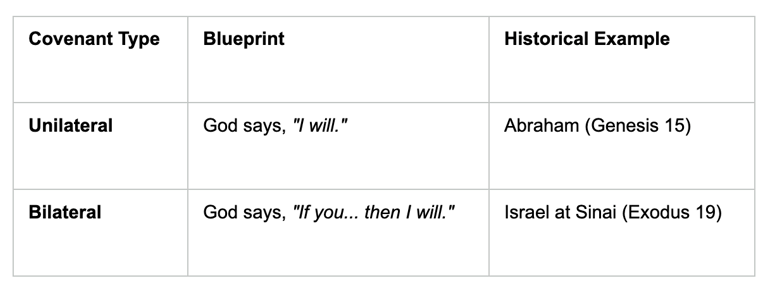
In the ancient Near East, a covenant-cutting ceremony looked exactly like this: they would slice the animals, lay them in halves, and the two parties would walk between them, basically saying, “If I break this covenant, may I end up like this animal.” But here's the twist: Abraham doesn't walk through. God puts him into a deep sleep, and then God alone passes through the pieces. This is what scholars call a unilateral covenant. One party takes full responsibility. No mutual promises. Just God saying, “Even if you fail, I won't.”
Now let's fast-forward to Exodus. Israel has been brought out of Egypt, and they're standing at Mount Sinai. God is ready to define the relationship again, but this time there is a shift:
“Now if you obey me fully and keep my covenant, then out of all nations you will be my treasured possession.”
— Exodus 19:5
Now we see a move into bilateral covenant territory. This is where both parties have skin in the game. This was totally normal in the ancient Near East; it mirrored suzerain-vassal treaties, where a powerful king (the suzerain) would cut a covenant with a weaker, dependent nation (the vassal). The suzerain would offer protection and provision, and the vassal had to obey certain stipulations or risk losing favor.
It's a little wild to think of Torah that way, but it's historically accurate. It helps us understand what's actually happening when Moses becomes the covenant mediator. As Hill and Walton note, these regulations were given to provide moral and religious instructions on how to keep the covenant.
But here's where it gets misread: the Law wasn't God trying to micromanage Israel into submission. It was a relational framework—a way of living faithfully within a covenant of love and rescue. Christians today often read the Law like it's just a checklist of things to avoid. But if we miss the covenantal context, we miss the point entirely. The Law reveals God's character. It was never about earning His favor; they already had it. Remember, He rescued them before they even obeyed a single command. In both cases, God initiates the relationship, God defines it, and God stays faithful.
The Framework of Vocation
Now that we've seen how God relates to the covenant, what does that have to do with calling? Well, everything. God hasn't stopped being a covenant God. If covenant is the framework, then vocation isn't just “What do I do with my life?”—it's who we are as a covenant people.
In Christ, we've been invited into a new covenant, the very one the prophets talked about:
“I will give you a new heart and put a new spirit within you... I will put my Spirit in you and move you to follow my decrees.”
— Ezekiel 36:26–27
“I will put my law within them, and I will write it on their hearts.”
— Jeremiah 31:33
The things we do aren't done for the sake of staying in the covenant—that part is secure. Instead, our calling is how we are invited to participate in what God is already doing in the world.
To map this out, we can look to spiritual theology—the branch of theology that focuses on the lived experience and practice of faith, observing the work of the Spirit in our lives. First, there's that undeniable universal call: the wide-open invitation to salvation. Then comes our bilateral response, which unfolds into two distinct layers: general callings and particular callings.
The General Callings (True for Everyone, Everywhere)
The general calls apply to every single person in the New Covenant community.
The Call to Love: Luke 10:27 says, “You shall love the Lord your God with all your heart and with all your soul and with all your strength and with all your mind, and your neighbor as yourself.” This is the heartbeat of it all. Love God, love your neighbor, and love yourself rightly. It's not optional; it's the actual shape of the Christian life.
The Call to Spiritual Formation: Or as some call it, discipleship. Romans 8:29 tells us we are “predestined to be conformed to the image of his Son.” This is our telos—the ultimate trajectory of who we are becoming.
The Call to Good Works: Ephesians 2:10 says, “For we are his workmanship, created in Christ Jesus for good works, which God prepared beforehand, that we should walk in them.” This isn't a call to hustle or climb some ladder of cultural impact. It's about simply walking in what's already been laid out on the path before you.
Martin Luther was a huge fan of these general calls. He believed your everyday station in life was a holy calling, and that God is just as present in the ordinary as He is in the pulpit. He famously noted that what you do in your house is worth as much as if you did it up in heaven for our Lord God. In other words, these are the biggest callings you'll ever receive—yes, even bigger than your career or your personal brand.
For John Calvin, vocation wasn't about climbing a divine career ladder either. It was about being faithful in the exact role you are currently in, because calling is always more about the Caller than the task. In his Institutes, he wrote that the Lord bids each one of us in all life's actions to look to his calling.
The Particular Callings (Unique to Your Story)
Particular callings are where your individuality gets drawn into God's purpose. They are personal, deeply contextual, and not always permanent. In his discourse on vocation, theologian Dr. John Coe breaks these down into five distinct categories:
The Providential Call: The invitation to accept and integrate your unique humanity—your story, your wounds, your weirdness—trusting that none of it is wasted in God's hands. This isn't self-help; it's seeing your actual life as raw material for God's redemptive work.
The Circumstantial Call: The invitation to say yes to God in the exact season you are currently in. It means not waiting for the next chapter to feel meaningful, and resisting the urge to romanticize a "higher calling" that always seems just out of reach. It's finding God right here, right now.
The Call of the Free Steward: This is what we usually think of when we say "calling" or "vocation." It's your job, your creative gifts, and your practical work in the world. Based on Jesus' parable of the talents, the key here isn't achieving worldly greatness; it's conducting business on the King's behalf until He returns, stewarding your tasks with joy, love, and freedom.
The Call to Sabbath: Yes, you read that right. You are actively called to rest and enjoy the life God gave you. You are not defined by your output. You are beloved.
The Call to be a Pilgrim and a Polemic: This one is a bit more existential. You are called to live as a pilgrim because this world can't contain all of who you are becoming; that inner restlessness you feel isn't a failure, it's homesickness. And at times, you are called to be a polemic—a living contradiction to this world's values. Not for the sake of being edgy or provocative, but because your very existence clashes with a culture obsessed with self-making and control.
To be a pilgrim and a polemic is to live as if the Kingdom is real: to quietly or boldly live in protest against despair, to choose joy anyway, to forgive when it costs, and to live with purpose even when the outcome is completely hidden from you. It's not performance; it's witness.
Fully Known
So, what are you walking in today? Are you confused about a job? Feeling stuck doing menial tasks? Maybe this season is simply an invitation to ask: “How can I love the people right in front of me well?” Even in the middle of the confusion, you can lean into the callings you know you have for sure: the call to love, to be formed, and to do good works.
I may not know how my pain, my weird gifts, or my barely-hanging-on bank account all fit into the big picture, but I can still accept God's invitation today, in this exact moment, to take one step forward in faith through the power of the Spirit. At the very least, you'll know you're walking in your calling to be spiritually formed.
You pronounced yourself a struggle bus, I think, but you are so deeply loved. And if it helps, we're never going to know the fullness of who we are on this side of eternity. There will be days when you feel overlooked, misunderstood, or unsure of your place, but you are already fully known.
“Now I know in part; then I shall know fully, even as I have been fully known.”
— 1 Corinthians 13:12
What does it all mean? It means your calling isn't just one thing. It's not a singular career path or a magic destination waiting to be discovered. It's a whole life lived in response to a God who initiates, invites, and walks right alongside you. This is what it means to be a called people.
So yeah, I quit my job to find my calling. What I found instead was a faithful God who is far more interested in who I am becoming than what I am achieving. And honestly? That's more than enough for today.
Until next time, spiral responsibly.Write your text here...