
Justin Martyr
S01E02
SPIRAL SEASON
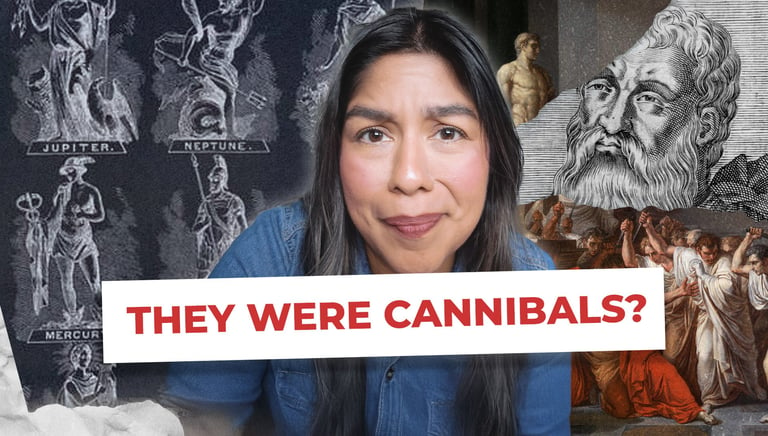
Before Christianity changed the world, it terrified it. Christians were accused of eating flesh, denying the gods, and plotting to overthrow the empire. One philosopher risked it all to set the record straight. This is that story.
Justin of Nablus
So who exactly was this first-century philosopher, and why is his last name "Martyr"? Well, his name is actually just Justin—or in Greek, Justinus. See, in his day, most people didn't have last names like we do now; they were usually identified by where they lived, their father's name, or what they did as a profession. So for now, we'll call him Justin of Nablus.
Justin was a Gentile, born near Jacob's Well in Flavia Neapolis around 110 A.D. His family was of Greek descent and likely wealthy, since he was able to receive a top-notch education before his conversion to Christianity. He studied in the schools of the philosophers, chasing after some knowledge that would satisfy the cravings of his soul. His dissatisfaction with most answers led him to become a disciple of Socrates and Plato. Yeah, those dudes.
For Justin and these schools of philosophy, the highest goal of life was for the life of the mind and the soul to be united in truth. In other words, harmony with truth, virtue, and the divine: eudaimonia (human flourishing). For Justin, truth wasn't abstract. It had to be coherent, eternal, ethically transformative, and worth building a life on.
The more he studied philosophy, the more he felt like each school got part of it, but not enough. Their truths were fragmented, their teachings self-glorifying, and their systems just weren't landing... until he encountered the prophets.
The Old Man by the Sea
In his work, Dialogue with Trypho, Justin tells of a chance encounter with an old man by the sea. The old man tells Justin that the Hebrew prophets—men like Moses, David, and Isaiah—hadn't spoken from guesswork, speculation, or wishful thinking, but had spoken by the Holy Spirit. They weren't philosophers chasing influence, applause, or followers. They were witnesses and truth-tellers, and their words pointed directly to a person: the Christ.
This was a person Justin had heard of but never truly understood. When the old man spoke of Christ as the Logos, Justin knew that word well from every philosophy class he had ever sat through. To the Greeks, Logos was cosmic reason, logic, the divine order behind everything. It was the thing that made truth possible—the thing every philosopher sought.
But then came the words of John 1: "In the beginning was the Word (Logos)..." and suddenly Logos wasn't just a principle; He was a person. The Word made flesh. The more Justin read, the more the prophets came alive. Their words weren't vague hopes or poetic guesses; they were fulfilled down to the detail in the life, death, and resurrection of Jesus. It revealed the God who created life, gave it meaning, and stepped in to redeem it. This wasn't just better philosophy—it was the end of philosophy. It was the answer his soul had been chasing.
Surviving the Roman Rumor Mill
So Justin has his life-altering realization: Christ is the Logos. Life makes sense now. But just because his inner world changed doesn't mean his outer world caught up with him. He's still very much living in the Roman Empire, surrounded by temples, gods, imperial cults, and festivals where everyone bows to Caesar.
Putting all your chips in with a once-crucified rabbi from a sketchy corner of the empire back then is kind of like saying in 2026, "I've been reading a lot about the Branch Davidians, and I think they were kind on to something." It was not a great look, and definitely not an easy time to be a Christian.
Christians didn't exactly blend in. They didn't party with the gods, they didn't swear loyalty to Caesar as divine, and notably, they weren't afraid of death. They lived by a completely different script shaped by peace, patience, and resurrection hope. Rome thought they sounded a little cultish, which is why Christians got hit with three massive allegations.
Let's look at how Justin boldly defended the faith against each one in his First Apology:
1. The Accusation of "Atheism"
Christians had earned the title of "godless," and to be fair, by Roman standards, they kind of were. They didn't believe in any of the Roman gods. Worshiping the pantheon wasn't just religion; it was social, political, and patriotic. The whole empire ran on honoring the gods. If you refused to participate, you weren't just weird—you were dangerous.
Justin owns the title directly:
"We confess that we are atheists, so far as gods of this sort are concerned, but not with respect to the most true God."
Translation: We're going to pass on your problematic sky people. Justin then calls out the double standard, pointing out how Rome handed out awards to poets who openly poked fun at Jupiter in theater pieces. He argues that the true God doesn't need material offerings from humans because He is the provider of all things.
2. The Accusation of "Cannibalism"
The rumors whispered that Christians met in secret to eat flesh and drink blood. Justin steps in to clarify the Eucharist:
Yeah, we eat bread and we drink wine, and yeah, we believe it's Jesus. But not in an "eat a corpse" kind of way. It's still bread, it's still wine, just leveled up. It is a sacramental mystery where God welcomes us to His table.
Justin explains that the food becomes the flesh and blood of Christ through a mystery he calls transmutation—a spiritual nourishment, not a physical devouring. (And yes, "transmutation" is distinct from Aquinas's later concept of "transubstantiation." Justin wasn't quoting the medieval scholastics!)
3. The Accusation of Subversion
Christians were viewed as a threat to the empire because they kept talking about a coming "kingdom" that would last forever and didn't belong to Caesar. Rome wasn't great at nuance; they heard "kingdom" and immediately thought coup, revolt, or armed insurrection.
Justin corrects the record: "When you hear that we look for a kingdom, you suppose, without asking, that we mean a human one." He explains that Christians are citizens of a better, unseen, eternal empire. Christians still pay taxes, follow the law, and pray for the Emperor—they just don't worship him. The kingdom wasn't spreading with swords; it was spreading with suffering, service, and conviction. And you can't easily suppress a people who aren't afraid to die.
A Witness to Truth
Faith is often painted as blind, rigid, or fearful of doubt. But Justin reminds us that the early church wasn't anti-intellectual. Faith was not opposed to reason, and Christianity was not afraid of hard questions. Justin's First Apology stands as one of the earliest, most robust articulations of Logos theology—proving that Christianity is historically grounded and intellectually alive.
He didn't weaponize the truth; he offered it. He wasn't trying to win arguments; he was trying to show the way. He models a powerful blueprint for us today:
Seek truth fearlessly: Justin wrestled with the biggest questions of life, beauty, and justice, tracking them all the way to the feet of Jesus.
Ask hard questions: Christianity isn't a fragile system. It can take the scrutiny.
Speak with boldness and gentleness: His apologies were laced with respect, logic, and profound hope.
Ultimately, Justin would take his passion to a very public end. Around 165 A.D., under the reign of Marcus Aurelius, he was arrested. He was executed by beheading alongside six other Christians for refusing to renounce Christ and sacrifice to the Roman gods.
We actually have the formal written court records of his trial preserved in the Acts of Justin the Philosopher and Martyr. When the Roman prefect pressured him to abandon his faith, Justin responded:
"No one who is rightly minded turns from true belief to false."
The word martyr literally means "witness." In the early church, it came to mean someone who witnessed to the truth of Christ through their death. Calling him "Justin Martyr" isn't just identifying how he died; it's honoring how he lived and what he stood for.
He kept wearing his philosopher's robe even after converting as a living testimony that he had found the true philosophy. He didn't abandon reason for faith—he found its fulfillment in the ultimate Philosopher King. God gave you a mind so that you would use it. Go deep, grow roots, and lean into the hard questions. There is nothing to fear, because the Logos—the source of all truth—is already there waiting for you.