
Manifest Destiny
S01E03
SPIRAL SEASON
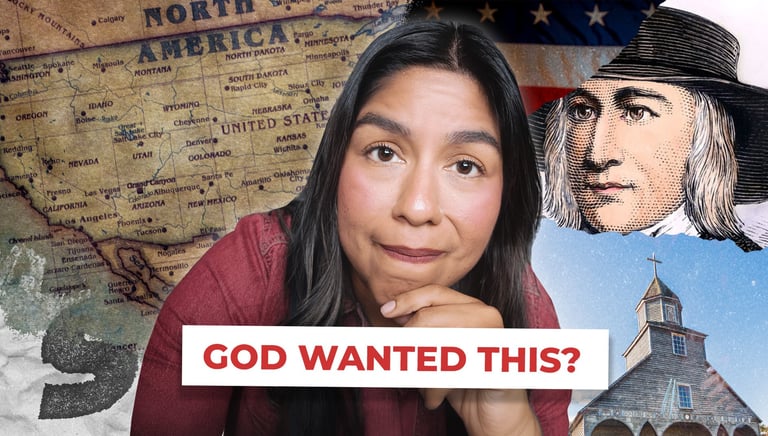
The frontier was wild, but the theology was wilder. Christian preachers claimed that God wanted the land, and they were his chosen to take it. They justified conquest, blessed genocide, and called it Manifest Destiny—a divine right to expand and to claim dominion in his name.
But buried in the dust were voices that said, "No, not in his name." So was there any good news in the Wild West, or just land grabs, bloodshed, and bad theology? Grab your canteen and let's head west.
The Roots of a National Theology
When we saw them last, the Puritans had just fled religious persecution in England. You'd think they'd be content with just being free, but there's always that one guy. John Winthrop was the leader of the first Puritan group to come over to the Americas and became governor of the new Massachusetts Bay colony. He wasn't just thinking survival; he was thinking divine PR. In his famous 1630 sermon, A Model of Christian Charity, he claimed that America would be a "city upon a hill," watched by the world, blessed by God, and exalted if its people were faithful. A chill little sentiment that became the blueprint for a national theology.
By the 1740s, the First Great Awakening was in full swing. Jonathan Edwards took that Puritan seed and watered it with intense adrenaline. He preached that America might just be the site of the Second Coming—the literal stage for the kingdom of God. No pressure, right?
But it didn't stop there. By the Second Great Awakening in the late 1700s, preachers like Lyman Beecher weren't just suggesting that America was special; they were saying it was necessary. Beecher claimed that the end times would begin in the American Republic, which meant we better build it fast.
And so the idea took root: If we expand, God expands with us. By the early 1800s, Americans were convinced they were chosen—a holy people with a holy mission. But as the wagons rolled west, that spiritual mission morphed into something a lot more political.
Defining Manifest Destiny
The term "Manifest Destiny" was coined in 1845 by journalist John L. O'Sullivan, who wrote:
"It is our manifest destiny to overspread the continent allotted by Providence for the free development of our yearly multiplying millions."
Translation: God gave us the land, so we better take it.
From Pulpit to Conquest
Now that the theological groundwork had been laid, Americans went all in, and fast. By the late 1800s, the pulpit and politics were basically holding hands. Nobody made that clearer than Protestant minister Josiah Strong. His 1885 book, Our Country: Its Possible Future and Its Present Crisis, was supposed to be a call for Protestant missions, but what he delivered was a full-blown theological endorsement of white supremacy and global domination. He wrote:
"This powerful race will spread itself over the Earth... upon Mexico, Central and South America, the islands of the sea, over Africa and beyond. Can anyone doubt the result will be 'survival of the fittest'?"
Strong was not subtle. He believed God had uniquely prepared the Anglo-Saxon race to lead the world and conquer it. Apparently, a lot of people agreed; the book sold over 200,000 copies, becoming a sort of spiritual guidebook for Christian nationalism and racialized Manifest Destiny.
This ideology didn't just live on the bookshelves; it moved into classrooms—or rather, boarding schools. The idea was horrifyingly simple: salvation equals assimilation, and providence equals conquest. Churches were preaching a different kind of gospel and calling it God's work.
Then came the land. A lot of it:
1803 (The Louisiana Purchase): Doubled US territory, acquiring 530 million acres from France. In the eyes of many Americans, this wasn't just a good deal; it was divine confirmation that the mission was working.
1803–1845 (The Frontier Rush): Settlers rushed to homestead, farm, and "civilize" the frontier. Indigenous peoples faced displacement, forced conversion, or death. Christianity became the justification for horrific acts against fellow humans who bore the image of God.
1846–1848 (The Mexican-American War): Texas was annexed, and Mexico was furious. War was declared by President James Polk, who was practically Manifest Destiny's hype man.
1848 (Treaty of Guadalupe Hidalgo): Gave the US over 525,000 square miles, including California, Arizona, New Mexico, Utah, Nevada, and Texas.
1846 (The Oregon Treaty): Signed with Britain, adding Oregon, Washington, and parts of British Columbia.
1854 (The Gadsden Purchase): Sealed the deal, grabbing southern Arizona and New Mexico for $10 million.
Just like that, by the mid-1800s, the US had reached the Pacific. Americans spread into every corner of their new territory, armed with maps, muskets, and a Bible. It was a geographic success and a moral failure. The belief that God had ordained this journey was no longer just a sermon—it was a national myth. What began as kingdom building became colonizing and conquest.
But the gospel was meant to be good news, so why did it leave so many people in ruin? Here's the thing: even in the dust and destruction, there were rebels. People who spoke up on behalf of reason and faithfulness, who followed a kingdom not acquired by force and power, but through surrender. Enter the Quakers.
The Quaker Counter-Rebellion
So who were the Quakers? You mean that guy from the oatmeal? Yeah, kind of. But the actual Quakers were a lot more hardcore than the branding lets on. They were a small but mighty spiritual crew founded by a fiery English preacher named George Fox.
The story goes that Fox was hauled into court for blasphemy. During the trial, Fox told the judge to "tremble at the word of the Lord." The judge snapped back saying “You quake!” and called them "Quakers," and just like that, it stuck.
To be clear, George Fox wasn't protesting the Mexican-American War or challenging Manifest Destiny from a soapbox in the 1800s—he lived two whole centuries earlier in 1600s England. But he lit the theological match and founded the Religious Society of Friends (better known as the Quakers). He preached a faith rooted in peace, simplicity, and radical equality. No pulpits, no war, no religious celebrity. Just people gathering in silence, listening for God, and actually doing what Jesus said.
While Fox never set foot on American soil, the fire he started caught. By the time Manifest Destiny rolled in with its rifles and revivals, the Quakers were some of the only ones saying, "This ain't it, chief." They stood up to power with four distinct core values:
1. Rejecting the "Chosen Nation" Myth
Quakers refused to believe that the US had some sort of divine right to conquer the continent. They weren't buying it. Instead, they called it what it was: moral compromise wrapped in patriotic language. Abolitionist John Woolman wrote, "Men having power too often misapplied it. We made slaves of the Negroes, and the Turks made slaves of the Christians." John Greenleaf Whittier, the Quaker poet behind Voices of Freedom, used his art to expose the brutality of slavery and the contradictions of expansion in the name of liberty.
2. Radical Integrity over Domination
The Quaker testimony of integrity wasn't just personal; it was political. They believed land gained through violence, deception, or domination was morally illegitimate. William Penn, founder of Pennsylvania, insisted on buying land from Indigenous tribes rather than just taking it. The Lenape people even called him "brother" because of how radically different his approach was. In 1681, Penn wrote to them:
"I desire to enjoy it with your love and consent, that we may always live together as neighbors and friends."
David Cooper, another Quaker abolitionist, went even further by writing public tracts calling out slavery. While most Christians stayed silent, some Quakers boycotted slave-made goods altogether and even left churches that tolerated enslavement. As Woolman dropped the mic: "To labor for a perfect redemption from this spirit of oppression is the business of the faithful."
3. An Uncompromising Peace Testimony
Quakers did not do war, period. They believed that violence, even when wrapped in a flag or around a pulpit, was incompatible with the gospel. While most churches blessed conquest, Quakers stood firm in their peace testimony, refusing to fight, fund, or cheer on American wars. William Savery, a Quaker elder, worked directly with Native tribes and freed slaves, pushing for policies of justice and reconciliation instead of domination. Their refusal wasn't passive; it was active resistance. Peace was the assignment.
4. Holy Simplicity
Quakers were serious about integrity in lifestyle, not just belief. They rejected luxury, debt, and exploitation. They wore plain clothes, refused to use titles, and even avoided using days of the week named after pagan gods (for example, saying "First Day" instead of Sunday). They believed that every part of life should reflect God's truth, so they dressed plainly, spoke plainly, and refused to flatter anyone. It was a quiet, counter-cultural rebellion, and it made noise.
Let Your Life Speak
While Manifest Destiny was shouting its divine entitlement across the frontier, the Quakers were sitting in silence, waiting for a word. And when it came, it sounded like peace, justice, and a refusal to play Empire in God's name. While the rest of the country chased dominion, profit, and a self-serving destiny, they chose humility. They didn't try to build the kingdom by conquest; they tried to live one into being—one honest word, one peaceful choice, one quiet act at a time.
No, they didn't get everything right, but their early witness was unmistakably courageous, and their legacy lives on through faithful Friends churches today.
It's easy to feel disillusioned when you look at the past and wonder if Christianity has ever been anything but violent, political, or self-serving. But stories like these remind us that there were always people who resisted—people who loved deeply, lived justly, and followed Jesus boldly, even when no one else would. We can still be those people today. In a world obsessed with influence and control, we can choose justice. We can choose to love what God loves, not by force, but by surrender.
Maybe that's the invitation: to let your life speak.