
Unhinged Origins
S01E06
SPIRAL SEASON
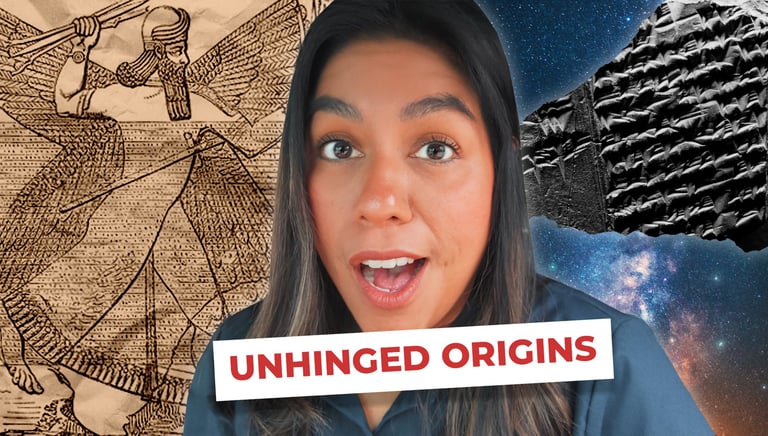
This is Marduk. Once a minor deity, now major, and absolute overlord. According to ancient Babylonian myth, he managed chaos by taking his grandma, Tiamat, slicing her up, and making the sky out of her rib cage. Then, he crafted humanity from blood, dirt, and maybe a little bit of spit.
Hello, welcome to existence! Why are you here? To serve the gods, clean their temples, and keep divine tantrums to a minimum.
It's not a lot, but it was the best folks living in the ancient Near East around the second millennium BC could hope for: stay out of the divine drama, and maybe you won't get wiped out by a sudden flood. But right in the middle of that neighborhood, a completely different story was being told. It was a tale of a God who didn't need slaves, didn't create out of boredom or bloodshed, and who shaped the cosmos with intention—placing humanity at the very center on purpose.
The Neighborhood of Genesis
Cultures all over the ancient world had their own unique origin stories—from elaborate Egyptian temple walls to Sanskrit hymns in India. Some are beautiful; some are completely bonkers. But to understand Genesis 1, we have to zoom in on its immediate neighborhood: the ancient Near East (ANE), featuring places like Babylon, Akkad, and Ugarit.
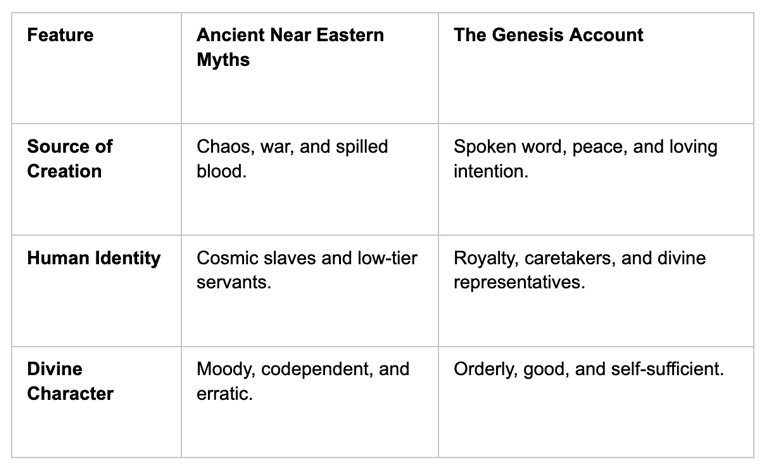
When you place the biblical creation account side-by-side with other ancient texts like the Enuma Elish or the Atrahasis Epic, you don't just get a story that sounds slightly different. You get a worldview that flips everything completely upside down.
To see how, we have to look at their cosmology—a culture's narrative about how the world began, who made it, and what it all means. Most ancient Near Eastern cosmologies follow a highly predictable four-part structure:
Primordial Chaos: The divine realm starts off as a swirling, chaotic mess ripe for a cosmic coup d'état between warring gods.
Creation Through Violence: The plot only moves forward when one god brutally defeats another to seize the celestial throne.
Humans as the Help: Human beings are never the heroes of the story; they are an afterthought, created purely to do manual labor for the lazy deities.
Temples as Remote Control Centers: Temples are set up as divine offices containing statues of the gods. The people must consistently bring sacrifices to keep these moody rulers pacified.
Across the board, the message of the ancient world was simple: The gods are chaotic, you are nothing but a cosmic janitor, so keep your head down and maybe you'll survive.
The Radical Departure
Then we open the Hebrew scriptures and read a completely different frequency:
“In the beginning, God created the heavens and the earth. The earth was without form and void, and darkness was over the face of the deep... And God said, ‘Let there be light’... Then God said, ‘Let us make man in our image’... And God saw everything that he had made, and behold, it was very good.”
— Genesis 1
Structurally, the elements of an ancient Near Eastern cosmology are still there. You have a formless void followed by the building of a grand cosmic temple over six days, which is then inaugurated on the seventh day when God rests.
But the reason why humans are placed in this temple is a massive theological mic drop.
Humanity is not created to be a slave class. We are created as the Imago Dei—the image of God. In the ancient world, kings would place physical statues of themselves in distant lands to claim sovereignty. The God of Genesis doesn't use stone statues. Instead, He breathes life into dusty human beings and installs them as His living representatives. Humanity is given a priestly vocation to carry His presence and extend the order, beauty, and justice of the garden sanctuary into the wild, inhospitable outer spaces.
This text boldly looked at the ancient world and declared: You farmer, you refugee, you woman—all of y'all are living rulers and image-bearers of the King.
Why the Latin? (A History Within History)
Why do we use a fancy Latin phrase (Imago Dei) for a book that was originally written in ancient Hebrew?
The phrase comes to us from the Vulgate, a Latin translation of the Bible completed by a priest named Jerome in 405 AD. The name Vulgate comes from the word vulgaris, which simply means "common" or "of the people." At the time, Latin was the everyday language of the Roman Empire, and Jerome wanted to get the scriptures out of scholarly circles and into the hands of ordinary folks.
Ironically, as the centuries rolled on, Latin stopped being common and became highly exclusive, locking the Bible away from the masses once again. By the 14th century, a rebel theologian named John Wycliffe stepped up to translate the Vulgate into Middle English so normal people could read it again. The church establishment was so furious about this that decades after Wycliffe died, they literally dug up his bones just to burn them.
But the Latin phrasing stuck around in church history. In Genesis 1:26–27, the Vulgate reads hominem ad imaginem et similitudinem nostram (“man in our image and likeness”). It directly translates the original Hebrew phrases: בְּצֶלֶם אֱלֹהִים (in our image).
Early theologians like Augustine and Thomas Aquinas adopted the Latin phrase Imago Dei to deeply investigate what it means to be a human being, and it has remained a foundational concept ever since.
The Concept Evolves
The story of the image doesn't stop in the dust of Genesis. In the New Testament, the Apostle Paul takes this ancient concept and anchors it directly to the person of Jesus:
“He is the image (eikon) of the invisible God, the firstborn of all creation.”
— Colossians 1:15
Jesus is the "Second Adam"—the perfect, unmarred expression of what a human bearing God's image is actually supposed to look like. Paul then writes in Romans 8:29 that followers of Christ are “predestined to be conformed to the image of his Son.” This means the image of God in you isn't a static stamp; it's a dynamic trajectory of who you are becoming.
Great thinkers throughout church history have looked at this mystery from different angles:
Irenaeus (2nd Century): Made a distinction between image and likeness. He argued we kept the "image" (our reason and free will) after humanity's fall into sin, but lost the "likeness" (our deep spiritual communion with God), which we now recover through Christ.
Augustine (5th Century): Located the image inside the human soul, specifically mirrored in our memory, understanding, and will.
Thomas Aquinas (13th Century): Emphasized our human intellect as the primary seat of the divine image.
John Calvin (16th Century): Argued that the image was catastrophicially ruined and obliterated by sin, yet its faint traces can still be found in our design.
Karl Barth (20th Century): Claimed the image isn't an individual trait at all, but is found entirely in our capacity for relationship, mirroring the relational, loving nature of the Trinity.
No matter the angle, the overarching baseline remains clear: Jesus is the true image, and we are called to actively participate in reflecting Him to the world.
3 Ways the Imago Dei Changes Everything
This isn't just an abstract theological theory to win trivia night. It directly dictates how you see yourself, how you treat your neighbor, and how you interact with the world on a random Tuesday.
1. You Are Not Your Own
You might be the main character of your own life, but you were crafted with profound intention. As Paul writes to the Ephesians, we are His workmanship, created for good works. Being made in the image of God is an identity claim. It completely detaches your worth from your productivity, your job title, your bank account, or your personality type. Your worth isn't something you earn; it's an inheritance. You are a beloved child, designed to mirror the Creator.
2. We Reflect God to Each Other
If every single human being is an image-bearer, then the community of faith is meant to act like a giant, spinning disco ball—with every diverse person refracting a different angle of the divine light. We desperately need each other to see the full picture. As martyr and theologian Dietrich Bonhoeffer beautifully wrote in Life Together:
“The Christ in his own heart is weaker than the Christ in the word of his brother.”
Sometimes, it is only through the voice and presence of another person that we can clearly hear and see the character of God.
3. We Reflect God to Creation
Human beings were intentionally designed for this planet. Genesis frames our primary role as gardeners, cultivators, and caretakers. We are called to bring beauty, order, justice, and shalom (holistic peace) wherever our feet touch the ground. The Imago Dei isn't a coat you get to take off when you leave church. Every room you walk into, every tough conversation you have, and every mundane task you complete is holy ground because you are carrying His image into it.
A Calling, Not a Performance
To wrap it all up, let's look to a beautiful insight from theologian John Stott:
“The image of God is not a possession but a calling.”
The Imago Dei isn't a prize we guard or a rigid performance standard we have to sweat through to live up to. It is a life we get to participate in by grace.
Yes, we are messy, wayward, and broken. But even a cracked mirror still reflects light. Your brokenness doesn't mean you stop bearing the divine design. Beneath your anxieties, your failures, and your hidden hurts, that original identity still pulses inside of you—eternally true and lovingly placed.
You have your Father's eyes. And the person sitting right next to you? They do too.
Until next time, spiral responsibly.