
What I wish they told me about God in church
S01E08
SPIRAL SEASON


Are you a spiritual overachiever? As in, did you memorize 42 Bible verses by the age of ten just so God wouldn't be mad at you? Same. They told me if I was good, God would stay. Then this disruptive Swiss theologian came along and said, “Girl, God never left.” Let's unlearn fear-based faith together.
Inheriting a Legacy
I don't know about y'all, but I grew up in a very Christian household. My grandfather was ordained. My dad was ordained. My uncles were ordained. Everywhere I looked... let's just say potlucks and pastoral credentials ran deep. And while I grew up surrounded by a lot of love, I also grew up with a whole lot of confusion about practical theology.
I accepted Christ at the ripe age of six because I was terrified I would go to hell if I died in a car crash on my way home from church. Yeah, that is a different spiral for another day. But for now, let me ask you this: Are there things you believe about God that you've inherited that might actually not be biblical?
That question was at the forefront for me when I got older. Somewhere in the wrestling, God invited me on an adventure through pain, through prayer, and through divinity school. Along the way, I met a rad dude with a similar story—a guy with his own theological legacy, raised in a deeply religious, highly academic Swiss Reformed family. But instead of following the expected path, he wrestled with culture, church norms, and the proper way of doing theology, bringing about one of the most influential works in modern Christian history.
Meet my friend, Karl Barth.
Who Was Karl Barth?
So who exactly is this guy, and why should we care about him today? Karl was a Swiss dude from a family of ministers, but he wasn't just some legacy kid toeing the line. From 1911 to 1921, Karl served as a local pastor in the tiny, working-class town of Safenwil, Switzerland.
In 1914, ninety-three German scholars—including Karl’s own mentors—signed a public manifesto supporting Kaiser Wilhelm’s war policy. It completely shook his trust in the theological systems he’d been handed. Meanwhile, in his own church, parishioners were fighting for a just wage, and Karl found himself not just at the pulpit, but in the struggle standing with them.
But here's the twist: even though Karl backed his beliefs with action, he didn't turn the gospel into mere social concern. He saw the danger in what theology was becoming, even at his young age. As theologians have noted, Karl was voicing a vital concern: contemporary Christian thought was in danger of becoming more anthropology (the study of humans) than theology (the study of God). In other words, he saw how theology had become a mirror of human culture instead of a critique of it.
So, as all of this brewed in him—World War I, cultural collapse, and personal disillusionment—Karl sat down to write a commentary on Romans to clarify his own thinking. Except, he accidentally rang the theological alarm bells. He later described it like this:
“I was like a man in a dark church tower who tripped and grabbed the bell rope to steady himself, and accidentally alarmed the whole town.”
That commentary sparked a massive revolution in 20th-century theology. The goal was to let the apostolic message of Paul's letter to the Romans break with full force on the present age. That message was not “you're doing great.” It was “Christ alone.” Karl would go on to write more than 500 books, sermons, and essays, culminating in his massive magnum opus, Church Dogmatics. Today, we're zooming in on one specific section: Volume IV.
From Transaction to Communion
Before we jump into Church Dogmatics Volume IV, let's pause for a second and consider how many of us have internalized the gospel. Let me know if this sounds familiar to you. Just like Karl grew up with a tradition he eventually had to wrestle with—a tradition he didn't throw out, but also didn't blindly obey—a lot of us were handed a version of the gospel that might have been well-intentioned, but missed the point.
As a pastor's kid, it was basically a requirement for me to know the Sinner's Prayer in the womb. I could walk a second grader through it over a juice box. But the version of the gospel I inherited was essentially: be good or burn. Fire insurance. You say the prayer to avoid something, not to embrace someone. Mostly, you just don't want to go to hell.
But here is the tragedy: you cannot scare someone into love.
The gospel is so much more than a way out of damnation; it's a way into communion—into Christ Himself. That's where Karl Barth changed everything for me. In Church Dogmatics, he writes about Jesus not as a "get out of hell free" card, but as the actual gift. Salvation is more than just bare existence; it is fulfillment:
“...the supreme, sufficient, definitive, and indestructible fulfillment of being.”
That is so fundamentally different from how I was taught to think about salvation. It's not a transaction; it is the deep, abiding presence of a God who simply wants to be with us.
3 Takeaways from Church Dogmatics (Vol. IV, Sec 57)
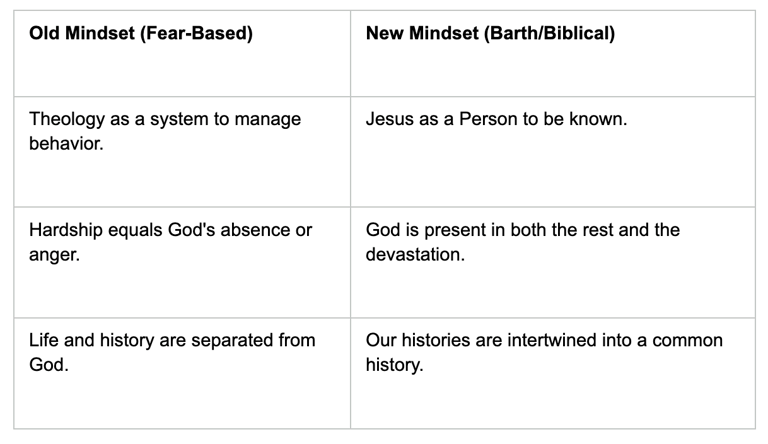
1. Jesus is the Person, Not the System
Jesus is a person. I know that sounds incredibly obvious, but it wasn't always that way for me. Growing up, I heard about Jesus constantly—Sunday school, midweek services, Christian radio. He was everywhere. But looking back, I hadn't really met Jesus. Christianity was more of a reputation. I wasn't just following Jesus; I was representing my parents, my family legacy, and the gospel. It was a system, and boy, did I know how to work it. Do this. Don't do that. Be better. Be quieter. Be good.
To this, Karl interjects:
“He is not merely the redeemer of our being, but as such the giver and Himself the gift of its fulfillment, and therefore the goal and end of the way of God.”
Jesus isn't just the path to the goal; He is the goal. He's not just the way to avoid hell and get into heaven—He is the gift Himself. Salvation isn't about getting good; it's about getting God. And not just eventually, but right now.
2. God With Us (Even When It Doesn't Feel Like It)
Let's be completely real right now: hardship is often treated as a failure of faith, as if pain somehow proves distance. But in my experience, it's in the darkest moments that God with us becomes undeniable. We are invited to become well-acquainted with the one Paul calls the God of all comfort. Karl puts it like this:
“God with us is true when the people is at rest. It is also true when the enemy invades and devastates the land. It is always true in spite of and in the most irresistible movements of history.”
God with us isn't a mood, and it's not dependent on your circumstances or your mindset. It is reality—a reality that doesn't disappear when life stops being aesthetic or controllable.
3. The Wild Reversal: Us With God
As if God with us wasn't already extraordinary enough, we get the wildest cosmic "Uno reverse card": us with God. Karl goes off, saying that what unites God and human beings is that He does not will to be God without us.
Think about that. Not out of loneliness or need, but out of relentless, overflowing love. This should completely transform how we view salvation. He doesn't just pardon us; He welcomes us.
What does this change?
Your Identity: For starters, it changes your whole identity. You're not a cosmic afterthought—you're family.
Your Purpose: We have a purpose that isn't tied to an outcome or a metric of behavior. Your unremarkable Tuesday is now fully a part of God's unfolding story.
Your Security: We are entirely secure. Karl writes that God creates us rather to share with us His own incomparable being, life, and action. He does not allow His history to be His and ours to be ours, but causes them to take place as a common history.
If your life and God's life are beautifully intertwined, you quite literally cannot outrun His presence. And that, friends, is where fear-based faith finally runs out of room. Because truly, perfect love casts out all fear.
Faith Without Fear
Here's the beautiful thing about Karl Barth: he didn't throw out everything he was raised with in a blaze of youthful rebellion. Instead, he investigated. He held his theology up to the light of Scripture, even when it meant questioning his own mentors and his surrounding culture. He was literally banned from Germany during World War II for refusing to go along with a version of Christianity that had been twisted to serve an empire.
When Karl encountered God, there was no room left for destructive fear—only conviction and a deep obedience to the supremacy of Christ.
So I leave you with this question to carry with you: What would your faith look like if fear was no longer the foundation?
Until next time, spiral responsibly.