
What If Doubt Is The Key To Faith?
S01E05
SPIRAL SEASON
Middle school was nuts. I had this best friend. We braided lanyards together, got down at Cat's Cradle, and then one day, boom. Friend dumped for the new girl, Olivia. No warning. Just, "She's cooler than you. Okay, bye." That could have been my villain origin story, but really, it was more my sad girl origin story.
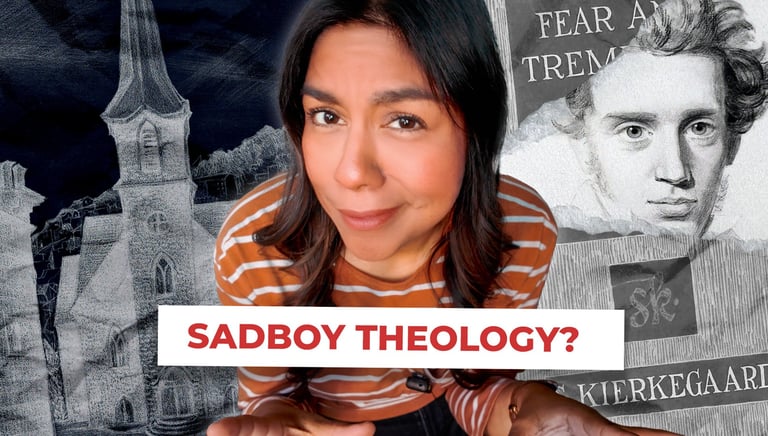
Which reminds me, have you ever heard about the first emo monk of modern faith, Brother Spiral? Okay, fine. I'm the only one who calls him that. But dude was Denmark's resident sad boy theologian. He spent his life writing, grieving, and yelling out into the ether about a faith that had to mean something.
Thankfully, his big asset wasn't meaningless, and he accidentally invented an entire branch of philosophy while also calling out an entire culture in the process. This one is for those sad boys and girls who still believe, even when it doesn't make sense.
Grief-Wired: Søren’s Origins
So what is it about grief that has the nerve to make us so deep? I'm like, excuse me? How is it that something so tragic can also make me so thoughtful, more honest, and even maybe more receptive to God? Rude. That's my story. And that's probably your story too, to some extent. And that's definitely Søren Kierkegaard's story.
Born in Copenhagen in 1813, the youngest of seven, by the time he was 21, he had lost five of his family members, including his mother. The man was grief-wired and—look, I haven't even mentioned that fiancée he broke up with because he thought he was too spiritually doomed to be loved. Let's just say Kierkegaard walked so that your emotionally unavailable ex could run.
But providentially, probably, grief didn't shut him down. It opened him up, and it gave him questions that an easy faith could never answer, and it pushed him into a life of, well, spiraling. But before he was the father of Christian existentialism, he was just a kid wondering, why does this hurt so much? And what do I do with an ache that never seems to leave? But he didn't just suffer. He thought his way through it, and when he couldn't think his way out of it, he started writing and doubting and then writing some more. And not in a neat Christian film kind of way, where all is resolved by Act 3. This was bone-deep, soul-splitting, "God, where are you?" kind of doubt. In other words, this is not a story about answers. This is a story about honest questions, the kind you only start asking once your world has already broken. So how is it that pain breeds doubt? And how does that doubt become the soil where a real faith can grow?
Two Ways to Doubt: Descartes vs. Kierkegaard
It's the 1600s, and René Descartes has famously decided to doubt everything. His senses, his memories, even that two plus two equals four. Because if he could doubt it, it might not be real. But the one thing he couldn't doubt? The fact that he was doubting, which meant he must be thinking, which meant he must exist. "I think, therefore I am." Boom! Modern philosophy is born. So for Descartes, true knowledge starts with doubt. If it can survive doubt, it can be trusted.
Now enter Kierkegaard a couple centuries later. Same method, very different vibe. He doesn't reject doubt. He leans into it, but not to prove that he exists. To ask, can I still believe in a God that I can't see, can't explain, and can't fully understand? And instead of demanding clarity to justify belief, he says something wild. Real faith comes when you leap after the doubt. He calls it the absurd. And we'll come back to that concept later. But for now, just imagine it's Abraham still trusting God, knife in hand. Not because it made sense, and definitely not because he knew the outcome. Faith isn't a strategy. It's not clarity. It's surrender in motion. So where Descartes used doubt to find human autonomy, Kierkegaard used doubt to surrender it.
Invitation 1: Moving Without Clarity
Kierkegaard didn't leave us a whole lot of answers, but he did leave us invitations. Let's take a look at two.
Clarity doesn't come before obedience. In Fear and Trembling, Brother Spiral doesn't give us five steps to peace. He gives us Abraham, standing on a mountain, knife in hand, heart in pieces.
He climbed the mountain even at the instant when the knife glittered. He believed that God would not require Isaac. He was indeed astonished at the outcome, but by a double movement he had reached his first position, and therefore he received Isaac more gladly than the first time.
That double movement Kierkegaard talks about: infinite resignation, meaning Abraham was fully prepared to lose what he loved most, and faith, because he still believed, by virtue of the absurd, that God would somehow keep his promise. Today we might say, "I'll trust when it's safe," or "I'll believe when I can see more clearly where this is going." But let's be real. That's not biblical faith. That's just control with spiritual branding. Abraham didn't wait for clarity. He moved forward in obedience, not based on logical reasoning or even a clear understanding of God's plan, but on an unwavering trust in God's promise, even when it seemed impossible.
In our own lives, we crave certainty. No tension, no paradox. But Scripture is full of exactly that.
"Lord, I believe; help my unbelief."
"We are sorrowful, yet always rejoicing."
"When I am weak, then I am strong."
Even the cross is a paradox—the deepest suffering and the ultimate hope held in one brutal, holy moment. Theologians call it the paradox of the kingdom: the already-not-yet. I know God is good, yet I'm mad as hell at him right now. But tension is also the place where grace breaks through and where God whispers, "You don't know the ending yet, but I've been here since the beginning." Christianity isn't tidy. It's absurdly authentic.
Invitation 2: Living an Honest Faith
While Søren was out here wrestling with God, pacing the streets of Copenhagen and writing like his soul was on fire, the church around him was chilling, reading through polite sermons with just enough Jesus to feel respectable, but not enough to feel disrupted. And Søren was like, "You mean to tell me y'all are this chill about the cross?" Because he believed real faith was supposed to do something to you—wreck you a little, change the way you walk, make you leap.
"Christendom has done away with Christianity without being quite aware of it."
He dragged the Danish State Church for baptizing people into default salvation, for handing out Christian identity like coupons, and performing religion like it was community theater. People who perhaps never once enter a church, yet all these people are recognized as Christians by the state, buried as Christians by the church, and certified as Christians for eternity. He went as far as to say that the cross—the actual symbol of sacrificial love and suffering—had been turned into a child's hobby horse, a literal toy, a cute accessory.
And listen, it wasn't just critique for critique's sake. It was grief, because Søren believed that the real thing was worth everything. Real Christianity, he said, should cost you something. If your faith never looks absurd to the outside world, you might be performing it instead of living it, because a faith that never requires a leap isn't faith at all. It's just religious cosplay.
Kierkegaard didn't want Christians to be nice. He wanted them to be honest. To tell the truth about their doubts, to wrestle, to risk, to live the kind of life where even one leap of faith—just one real, trembling moment of surrender—meant you had actually shown up for something real. So yeah, if Søren had to spiral, you'd better believe the rest of us are invited to, too.
Where Grace Wants to Meet You
So what do we do with all of this? How do we live these ideas when faith feels like a slog and obedience feels like walking off a cliff? What does it look like to keep showing up when clarity doesn't come, when the map never downloads, and God feels more like silence than certainty?
Maybe spiraling isn't a sign that you're losing faith. Maybe it's the beginning of something deeper. Something real. Because here's the mystery: faith isn't something we muscle into being. It's a grace we step into, a gift granted by the one who already knows how the story ends.
Take it from Brother Spiral himself. He didn't avoid the spiral, but he didn't let go. And more importantly, God didn't let go of him. So if you're in the tension, in the fog, and the annoying both-and, you're not failing. You're right where grace wants to meet you, because God isn't just at the finish line. He's in the pain. He's in the questions. He's in the trembling leap—the kind that still whispers, "God, I don't understand, but I'm not letting go." Brother Spiral knew that, and maybe, just maybe, we can too.