
Why the Bible Blows Up Our Walls
S01E07
SPIRAL SEASON
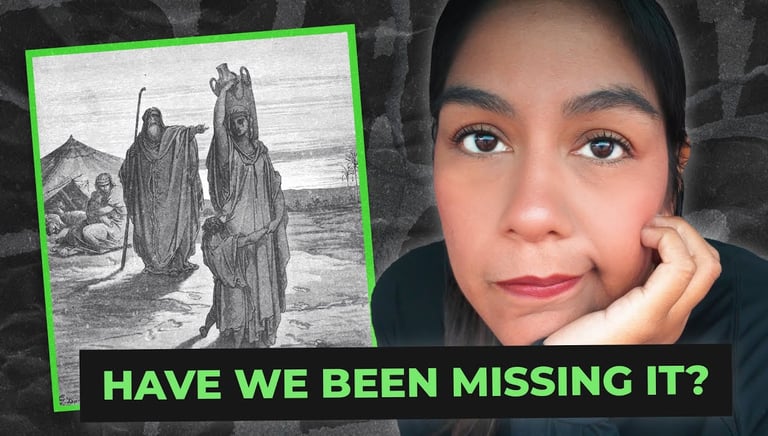
We’ve been here before. Cities burning, people yelling about borders, and everyone arguing over who counts as the "right kind of citizen." But what if God’s people have always been called to subvert the powers of exclusion? What if we are supposed to extend a type of welcome that is completely radical?
The Exclusionary Blueprint
The ancient world was not a friendly place for outsiders. In most ancient Near Eastern cultures, foreigners were viewed purely as threats—people to be conquered, enslaved, or eliminated altogether. If you didn’t belong to the right tribe, family, or nation, your life was constantly at risk. Even when hospitality did exist, it was transactional at best; it was an elite practice tied to power, wealth, or political advantage.
In the earliest legal systems, the law applied almost exclusively to citizens, landowners, and elite classes. Foreigners simply weren't part of the social order:
The Code of Ur-Nammu: Foreigners had little to no legal standing unless they had the protection of a powerful patron.
The Code of Hammurabi: Most legal protections focused entirely on landowners, soldiers, and officials. Foreigners were left wide open to exploitation, forced labor, or being treated as natural enemies.
The Middle Assyrian Laws: These codes were even harsher, dishing out brutal punishments for women, slaves, and anyone outside the elite class. Foreigners were treated like war captives or political pawns.
The Hittite Laws: While a little more chill, this code still only made limited space for guest workers and seasonal laborers. Even then, everything depended entirely on the mercy of the host.
But this is where it gets interesting. In the middle of all these very human power structures full of fear and control, the God of Israel does something entirely different.
Built Into Israel's DNA
When God called Israel to be His people, He built their entire national identity on one strange, counter-cultural command:
“Love the foreigner, for you yourselves were foreigners in Egypt.”
— Deuteronomy 10:19
This wasn’t just an ethical rule; it was deeply personal. Israel knew exactly what it felt like to live as strangers in a land—oppressed, displaced, and unwanted. God didn’t want them to forget that raw experience. Instead, He built that memory right into their DNA to shape how they treated others.
In Leviticus, He takes it a step further:
“When a foreigner resides among you in your land, do not mistreat them. The foreigner residing among you must be treated as your native-born. Love them as yourself.”
— Leviticus 19:33–34
Even within Israel itself, the tribe of Levi lived as a kind of stranger. Unlike the other tribes, they didn’t inherit land. Instead, God Himself was their inheritance. Their very lives were a constant reminder that belonging isn't about power or property; it’s about covenant. It was about being welcomed into God's life.
As Old Testament scholar John Goldingay puts it in his book Israel’s Law, biblical law extends to people whom other ancient law codes largely ignore, offering protection to those who would otherwise be marginalized.
And why? Because it’s who God is.
“He defends the cause of the fatherless and the widow, and loves the foreigner residing among you, giving them food and clothing.”
— Deuteronomy 10:18
This is the God who hears. The God who saw Hagar weeping alone in the desert; the God who heard the cries of Israel under Pharaoh’s oppression. This is the God who acts. And His people weren't called just to survive—they were called to be a blessing to the nations, reflecting His radical welcome in a world that only knew exclusion.
New Testament Amplification
The New Testament doesn’t water this down; it completely amplifies it.
At Pentecost, when the Holy Spirit arrives, the very first sign is a wild, multilingual moment. Parthians, Medes, Elamites, Cretans, and Arabs all hear the good news in their native languages. This wasn't just a cool supernatural stunt; it was God making a point right from the jump: everyone is invited to the table.
Then Paul comes along and drives the nail home:
“There is neither Jew nor Gentile, neither slave nor free, nor is there male or female, for you are all one in Christ Jesus.”
— Galatians 3:28
He repeats this theme to the Ephesians, declaring, “You are no longer foreigners and strangers, but fellow citizens with God’s people and also members of his household” (Ephesians 2:19). The church isn’t a gated community. It’s a family. It’s a table.
That table is open because of Jesus, who didn't just preach hospitality—He embodied it. He heals Gentiles, praises the faith of a Roman centurion, and tells the story of the Good Samaritan, completely flipping the dominant "us versus them" narrative.
Then, He does the most radical thing of all: He becomes the outsider. As Philippians 2 notes, He emptied Himself, taking on the form of a servant. Jesus steps outside so that we can be brought in.
The early church carried this forward. The Church Fathers spoke of hospitality as a direct way of receiving Christ Himself. In the sixth century, the Rule of Saint Benedict explicitly commanded that "all guests who arrive be received like Christ," because every person—every outsider—bears God’s image.
Here is where this gets a little uncomfortable for us. Sometimes we say things like, "Well, I’d be open to welcoming them if they just went about it the right way." But if we pause for a second, isn't that the exact opposite of how we were received by God? Jesus didn’t wait for us to get our act together. He didn’t say, "Once you meet my standard, I’ll consider going to Calvary." He made a way when we couldn't, extending His welcome long before we could ever respond perfectly.
3 Radical Truths for Today
This conversation pushes us because it isn't about ancient laws or theological theories. It’s about how we live right now as God’s people in a world still obsessed with borders, tribes, and power.
1. King Over Country
I'll just say it: America is not the center of God’s universe. For some of us, that is incredibly hard to hear. Over the last few decades, the lines between the Kingdom of God and the kingdom of the red, white, and blue have gotten blurry. But our ultimate identity isn’t tied to a flag; it’s tied to a King. His reign transcends every nation, every political system, and every cultural border.
“Therefore, since we are receiving a kingdom that cannot be shaken, let us be thankful, and so worship God acceptably with reverence and awe...”
— Hebrews 12:28
2. Hospitality is Spiritual Resistance
In a world consumed by fear, exclusion, and tribal loyalty, radical welcome isn't just a nice, polite idea—it is a form of protest.
In The Prophetic Imagination, Walter Brueggemann writes:
“Empire lives by anxiety and greed. The abundance of God permits us to live by trust and generosity.”
Empires operate on fear and scarcity. God’s people, however, are called to live by trust and generosity, standing firmly against systems that dehumanize and say, "You don't belong unless you meet my standards."
Theologian Christine Pohl adds in Making Room that hospitality is not an option, nor is it limited to those who are specially gifted for it. It is a necessary practice in the community of faith. Radical welcome isn't weakness; it’s spiritual warfare. It completely dismantles the enemy's favorite weapons: fear, pride, tribalism, and self-protection.
3. Love Relentlessly
Radical welcome will cost us something. But our personal comfort is not God’s priority—He loves us too much for that. He didn’t call us to safety; He called us to love. Jesus explicitly frames it this way in Matthew 25: when you welcome the stranger, you welcome Him.
Following Jesus isn't defined by what political party you vote for, but you cannot follow Jesus and simultaneously ignore the outsider. The Kingdom will always demand more than tribal or political loyalty. We are called to reflect His nature above all else.
“By this everyone will know that you are my disciples, if you love one another.”
— John 13:35
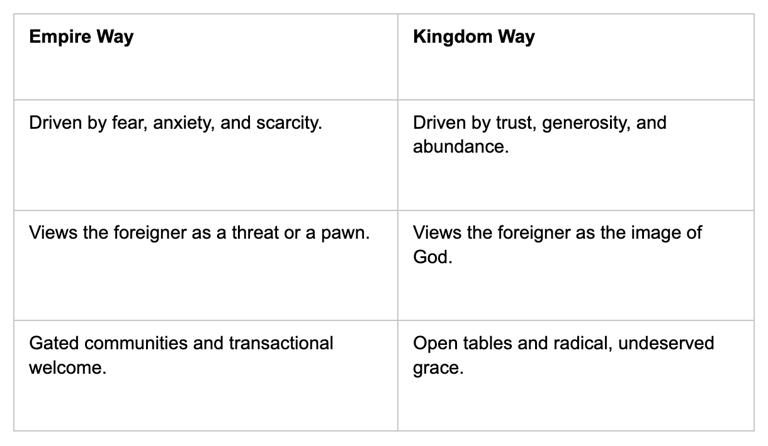
We have received a radically undeserved welcome, and that is exactly the kind of welcome we are called to extend.
So today, look around your own life and ask: Who is still standing outside? Where can I open the door just a little bit wider? Who needs to know that there is still room at the table? The Kingdom is open. The table is set. Who are we welcoming in?
Until next time, spiral responsibly.